
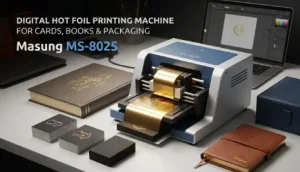
Foil has always signaled that a printed piece is worth a second look. A gold-embossed title on a book spine, a metallic monogram on an invitation, a silver logo pressed into a gift box — these details cost more to produce than flat ink, and buyers can tell. For decades, getting that effect meant commissioning a metal die and running it on a hot stamping press. That workflow still works well for long, repeatable runs. But a growing share of print jobs today are short, personalized, or one-off, and that’s where a digital hot foil printing machine changes the economics.
The Masung MS-8025 digital hot foil printer is built specifically for that gap: small and mid-volume foil work where cutting a custom die for every design isn’t practical.
The Market Shift Behind Digital Foil Printing
The push toward digital foiling isn’t happening in isolation it tracks a broader move in the print industry toward shorter runs and more digital output generally. Smithers, a research and consulting firm that tracks the global print market, valued the digital print sector at $167.5 billion in 2025 and forecasts it will reach $251.1 billion by 2035, a period in which digital print volume is projected to grow by roughly 54% as higher-throughput equipment comes online. Smithers’ packaging-specific research tells a similar story: global packaging print value was estimated at $504.9 billion in 2024, with growth forecast to $604.0 billion by 2029, driven in large part by demand for shorter runs and greater SKU variation rather than growth in total printed volume alone.
A separate Smithers analysis of digital print adoption notes that as run lengths continue to fall and print ordering increasingly moves online, customization and personalization are becoming standard expectations rather than premium add-ons. That shift is the direct commercial backdrop for a machine like the MS-8025: die-based finishing methods scale efficiently with volume, but they scale poorly with variety, and variety is what more of the market is now asking for.
What Is a Digital Hot Foil Printing Machine?
A digital hot foil printing machine applies metallic or pigmented foil straight from a computer file, using a heated print head instead of a custom-engraved die. It behaves less like a stamping press and more like a specialized thermal printer which is exactly the category the MS-8025 sits in. The distinction matters for buyers because it changes what drives cost and turnaround: on a die-based machine, cost is concentrated in tooling and scales down poorly for short runs; on a digital unit like this one, cost sits mainly in the foil ribbon itself, so a run of twenty pieces and a run of two hundred carry roughly the same per-unit setup cost.
Who Makes the MS-8025: About Masung
Founded in 2006, Masung Group is a professional manufacturer specializing in printing and scanning solutions for global markets. Its product portfolio includes receipt printers, kiosk printers, POS printers, thermal transfer printers, label printers, wristband printers, traffic sign printers, and barcode/QR code scanners.
With extensive OEM/ODM capabilities, Masung works with overseas distributors, system integrators, and businesses to provide customized hardware and integrated printing solutions. Its products serve diverse industries, including retail, healthcare, apparel, logistics, manufacturing, transportation, and self-service.
With a focus on product quality, innovation, customization, and reliable technical support, Masung Group is committed to building long-term partnerships and delivering flexible printing solutions tailored to the needs of customers in different international markets.
Inside the MS-8025: How It Works
Unlike a conventional foil stamping press, the MS-8025 doesn’t use a metal die at all. It’s a thermal transfer printing machine that applies foil directly from artwork sent from a computer, the same basic principle used in thermal label printers but adapted to lay down metallic and pigmented foil instead of ink ribbon.
Print Head, Resolution and Speed
The print head — an original Japanese ROHM unit rated for roughly 150,000 meters of service life — delivers 300 dpi resolution, which is enough to reproduce fine text, signatures, and detailed logo work cleanly rather than as a blurred metallic block. ROHM is a long-established Japanese electronics manufacturer whose thermal print heads are used widely across barcode, receipt, and label printing equipment, which is the same underlying component category this machine’s foil-transfer mechanism is built on. Print speed on the MS-8025 is adjustable between 20 and 60 mm/s, so operators can slow down for dense or delicate patterns and speed up for simpler jobs.
Working Area and Material Range
working area is a 57mm print width by 250mm print length, and the machine accepts material up to 30mm thick — enough to stamp not just paper and card stock but rigid board, wood-panel packaging, and leather goods, according to Masung’s product listing.
That combination of narrow print width and generous material thickness tells you what the MS-8025 is actually good at: precise, localized foil application — a title on a book cover or spine, a monogram on a leather journal, a small brand mark on a box panel, a name on an invitation — rather than covering a full-bleed poster-sized surface in foil.
Connectivity and Setup
It runs from USB 2.0, works across AC110–240V power without regional restriction, and Masung states it requires no proprietary design software and supports offline output once a job is loaded, so it isn’t tied to a particular operating system or CAD environment.
Digital Foil vs. Die-Based Hot Stamping
Traditional hot foil stamping presses foil through a heated metal die, and that die has to be custom-manufactured for every unique design — a real cost and lead-time commitment. It remains the more economical route for large, identical runs, and it can still achieve a distinctive debossed, tactile feel that some brands specifically want. Market research firm Research Nester estimates the global hot stamping foils market at roughly $2.58 billion in 2025, growing at just over 4% annually through 2035 — a sign that die-based stamping is still expanding, not disappearing, largely on the back of high-volume packaging and product decoration work.
A digital hot foil printer skips die production entirely: change the file, and the next piece can carry a different design, without new tooling. On the MS-8025 specifically, that means no plate-making step between finalizing artwork and running the job — the design is sent from a computer and printed directly. That’s what makes variable data and personalization — a different guest name on every invitation, a different serial number on every certificate — realistic on a machine like this one in a way it simply isn’t with a fixed die. Neither approach makes the other obsolete; the right choice depends on run length, design variability, and how much lead time a project can absorb.
Applications: Cards, Books and Packaging
The MS-8025’s 57mm by 250mm working area is the practical constraint that defines what it’s suited for: it’s built to foil a discrete element within that footprint — a name, a logo, a title, a short line of text — rather than to blanket an entire sheet or box face in metallic finish. Within that constraint, a few applications stand out.
Business cards and stationery fit comfortably inside the working area, since a name or logo on a standard business card sits well within 57 x 250mm — a common use case for print shops adding a foil tier without a stamping press. Greeting cards and invitations often need small, variable-artwork runs, which is the scenario a no-plate-making workflow is built to handle. Book covers and spines work within the 30mm material thickness ceiling — a title or author name stamped along a spine or on a cover panel is realistic; foiling an entire cover design edge-to-edge is not, given the print area. Packaging and boxes can use the machine for a logo or seal on a box panel, provided that element fits the working area and the board doesn’t exceed 30mm — larger box faces or full-panel foiling fall outside what this machine is built for. Certificates and promotional pieces round out the list, where a numbered element or short signature line adds a finishing touch without needing a die.
What to Check Before Buying a Digital Foil Printer
A few questions matter regardless of which digital foil machine you’re considering: What’s the actual print/stamping area, and does it match your typical job size? What substrate thickness and texture range is supported will it handle your card stock, leather, or box board reliably? What foil ribbon colors and widths are compatible, and what do consumables cost per job? How is artwork prepared and sent to the machine, and does that fit your existing design workflow? What’s the realistic throughput for your volume, and what does routine maintenance print head cleaning, ribbon handling involve? Finally, weigh total cost of ownership against a traditional stamping press quote for your specific run lengths; digital foil earns its keep on flexibility, not necessarily on unit cost at high volume.
Conclusion
Foil finishing used to force a choice between two extremes: pay for a custom die and commit to a large run, or skip metallic embellishment altogether. Digital hot foil printing machines like the MS-8025 sit between those extremes, built for the jobs printers turn away most often small batches, personalized pieces, and designs that change from one order to the next. Its narrow, precise print area and 300 dpi resolution won’t replace a die press on a packaging line running tens of thousands of identical boxes, but for cards, book covers, and short packaging runs, it removes the tooling cost that makes foil impractical at low volume. For a print or packaging business that regularly turns down small foil jobs, that gap is worth solving with the right equipment rather than routing every request to an outside finisher.
Full specifications and images for the machine discussed in this article are available on the official Masung MS-8025 product page.